
Dumps
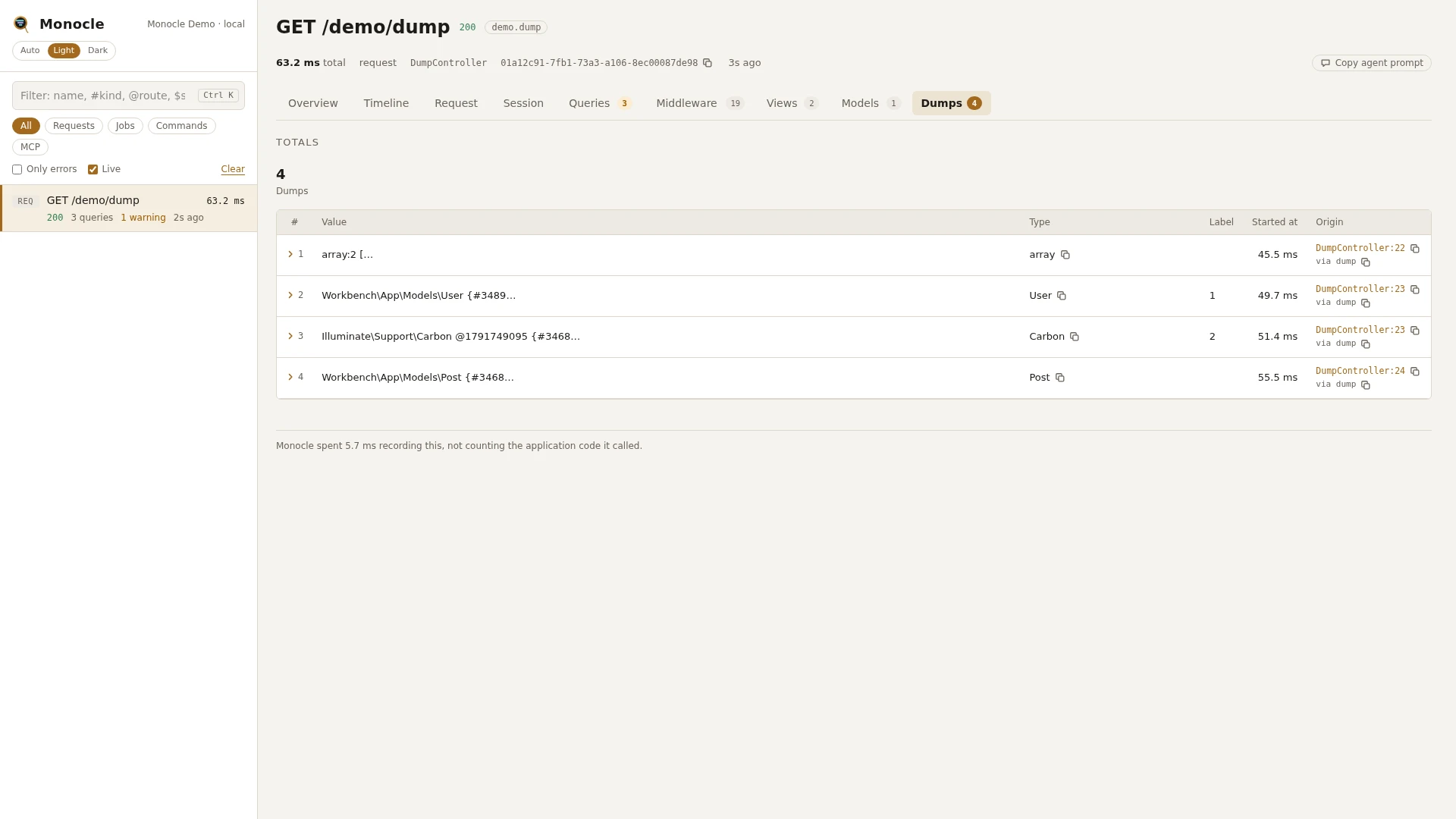
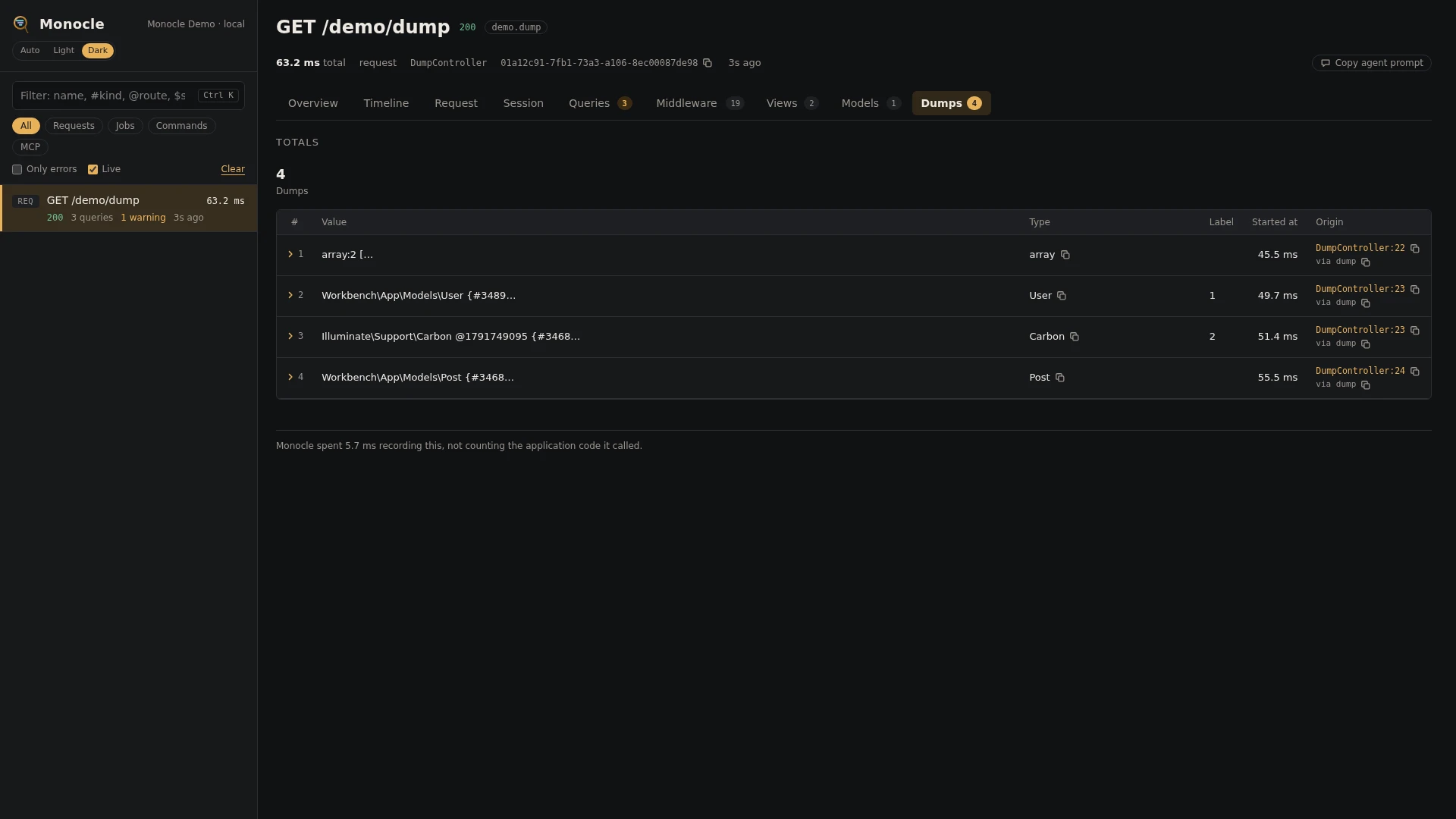
The dumps lens records every value passed to dump() and dd() during a capture, with where it was called. You still see the output where you normally would. A capture ended by dd() is still stored, marked as ended at shutdown.
Rows
Every row in the dumps section has these fields:
| Field | Meaning | Unit | Missing when |
|---|---|---|---|
value | The dumped value as text, the way dump() prints it, with the properties listed under mask.objects masked | never | |
tokens | The same text split into styled pieces, used by the dashboard to colour it | never | |
type | Type of the value, such as array, string, int or App\Models\User | never | |
label | The name of a named argument (dump(user: $user)), or the position (1, 2, ...) when several values are dumped in one call | null when a single value was dumped without a name | |
is_dd | true when the value came from dd() (also ->dd() on a collection or query) | never | |
time | When the value was dumped, counted from the start of the capture | ms | never |
origin | The file and line of your code that called dump() or dd(), with a short call chain | null when origin.enabled is off |
dump($a, $b) gives one row per value.
Totals, warnings and errors
The summary gets these totals when at least one value was dumped:
| Total | Meaning |
|---|---|
dumps | Number of dumped values |
dd_calls | Number of values dumped by dd() |
Warnings: when dd_calls is above 0, the summary gets one warning: dd() ended the process before the response was sent.
This lens reports no errors.
In the dashboard
The Dumps tab lists the dumps in order with the first line of each value, its type, label, whether it came from dd(), when it happened and the line of code that called it.
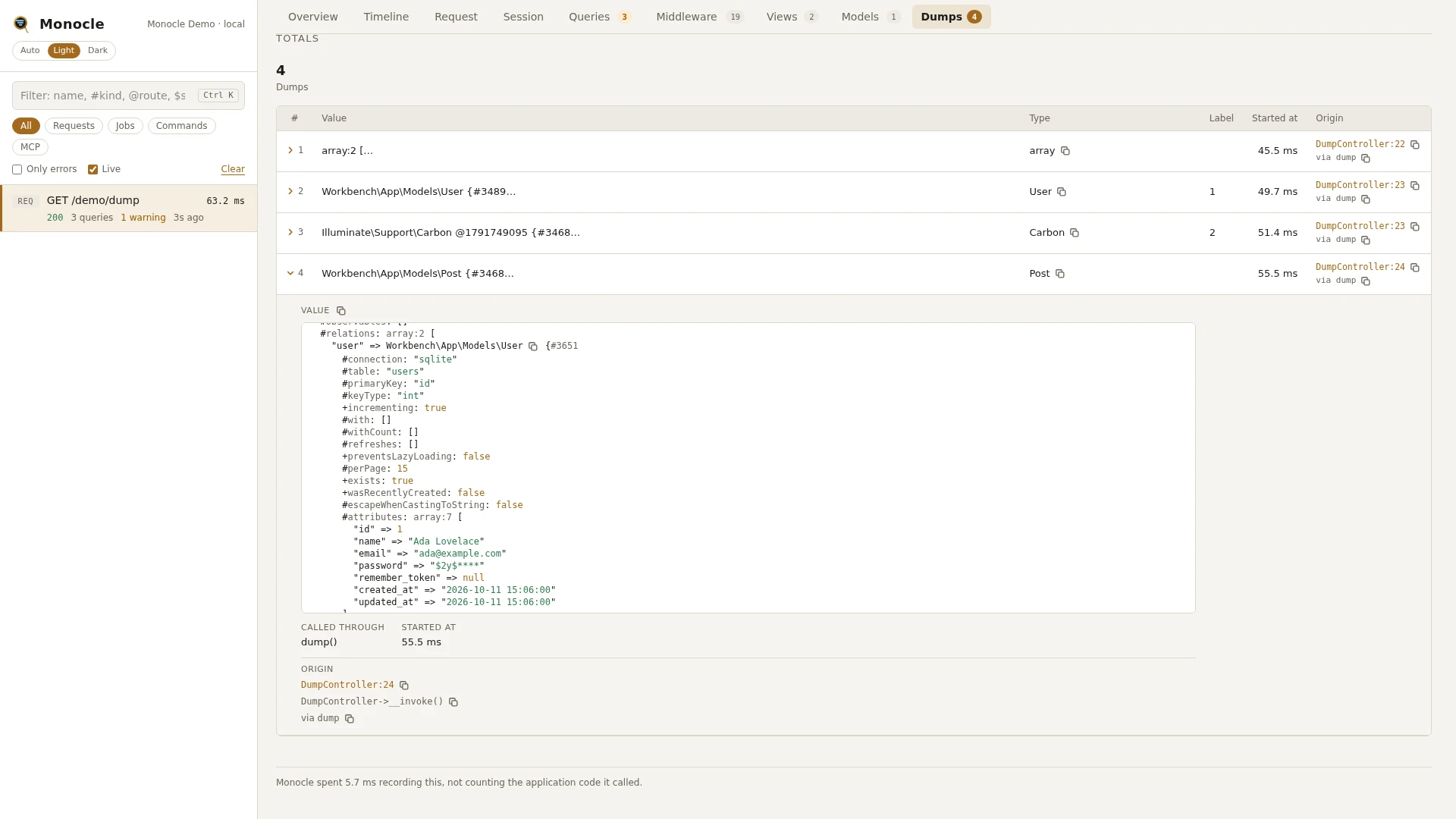
A row folds out to:
- the value as
dump()prints it, coloured (strings, numbers, property names), with every class it names linked to your editor when one is set up, and a copy button - whether it was called through
dump()ordd(), and when - the line of code that called it
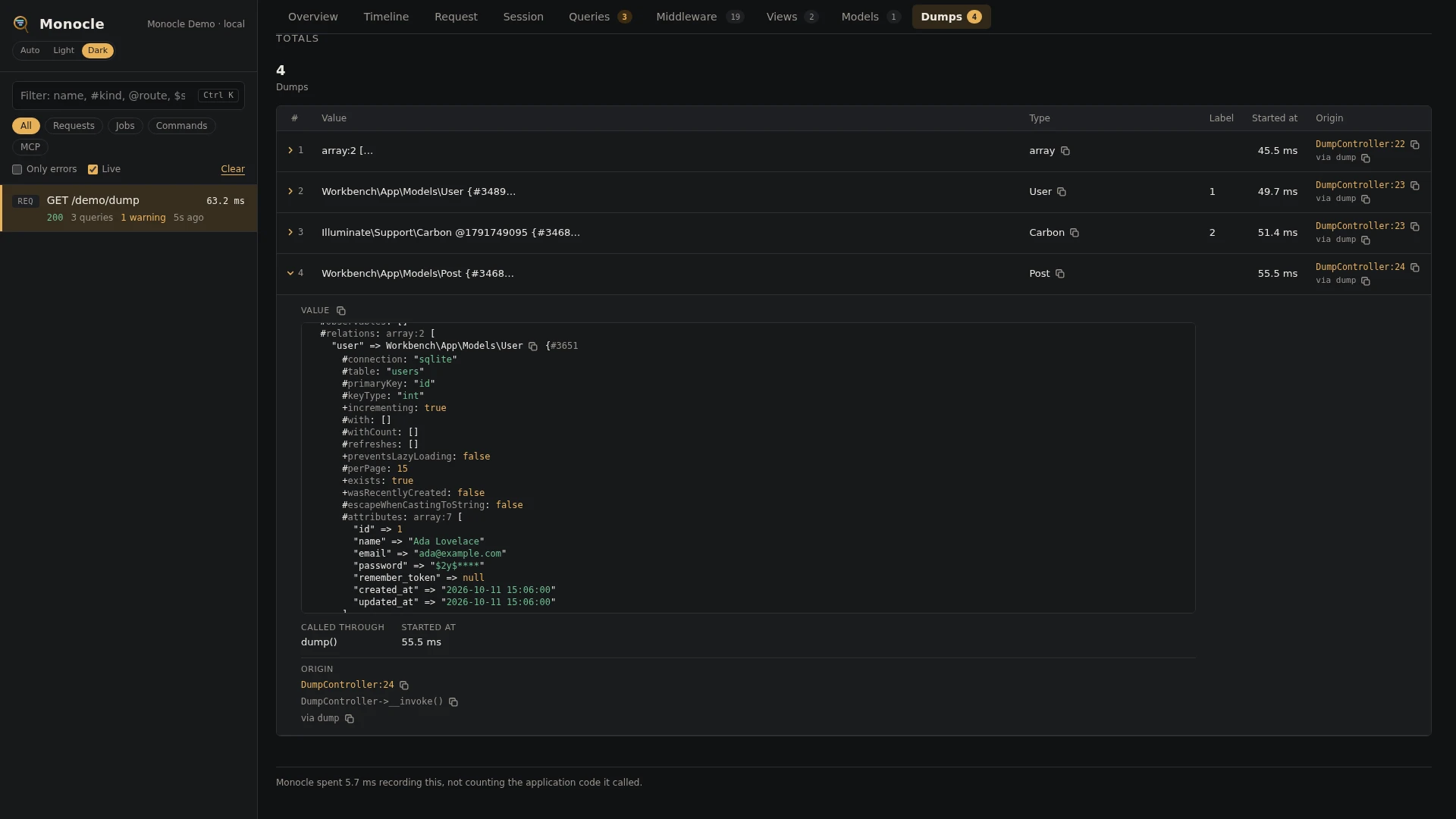
A dump of a model that holds other models, such as a post with its author and comments loaded, folds out to the whole tree:
For agents
monocle-rows: what the latest capture dumped, and from where. Leave out tokens, which repeats the value.
{"section": "dumps", "fields": ["label", "type", "value", "is_dd", "origin"]}monocle-rows: the value dd() stopped on.
{
  "section": "dumps",
  "where": [{"field": "is_dd", "op": "=", "value": "true"}],
  "fields": ["value", "origin"]
}monocle-list: recent captures with dumps left in them.
{"has": ["dumps"], "since": "1h"}Configuration
The lens is on by default and has no options. In the lenses block of config/monocle.php, key it by its class: true runs it, false turns it off (see Lenses).
Other settings that affect this lens:
mask.objectslists properties to mask in dumped objects, by class or interface. By default thepassword,remember_token,two_factor_secretandtwo_factor_recovery_codesof everyAuthenticatable(your user models) are masked. On Eloquent models the names are attributes. A list keyed byDumpLens::classadds to the shared one for this lens only.mask.usingis the mask used for a property listed without a mask of its own. Empty (null) values are left as they are.origindecides whether rows carry the line of code that calleddump().exceptkeeps whole requests and commands out of recording, including their dumps.
Masking only changes what Monocle stores. The output you see from dump() itself is not masked.
// config/monocle.php
use App\Models\Card;
use ExeQue\Monocle\Lenses\DumpLens;
use ExeQue\Monocle\Support\Masks\FullMask;
use Illuminate\Contracts\Auth\Authenticatable;

'lenses' => [
    // ...
    DumpLens::class => true,    // false to turn it off
],

'mask' => [
    // ...
    'objects' => [
        Authenticatable::class => ['password', 'remember_token', 'two_factor_secret', 'two_factor_recovery_codes'],
        Card::class => ['number' => FullMask::class],
        DumpLens::class => [Authenticatable::class => ['email']],
    ],
],
Requirements and limits
- Nothing to install: it uses Symfony's VarDumper, which Laravel ships with.
- Only
dump(),dd()and other calls that go through VarDumper are recorded.var_dump(),print_r()andechoare not. - Only objects whose class or interface is listed under
mask.objectsare masked. Arrays and strings are dumped as they are, so a token in a plain array is stored unmasked.